Shower head water softener: most of them can't soften water
Updated Oct 25, 2026
Search "shower head water softener" on Amazon or Walmart and you'll see pages of results from $15 cartridges to $199 "water softener shower heads," prices checked August 2026, many with thousands of reviews, promising to soften hard water. Almost none of them can. They are chlorine filters wearing the word "softener" on the listing, and the way to catch them takes about ten seconds once you know where to look.
The ten-second listing check
Scroll past the title to the materials or media list. You'll see some mix of: KDF-55, activated carbon, calcium sulfite, vitamin C, ceramic balls, "mineral beads," or a stage count like "15-stage" or "20-stage."
Every one of those is filtration media. All of it targets chlorine, sediment, and odor. None of it removes calcium or magnesium, because hardness minerals are dissolved ions that pass through filter media untouched. The full chemistry is on our page about why filter media can't remove hardness, but the shopping rule is short: no ion-exchange resin and no salt regeneration means it cannot soften water, whatever the title says.
The stage count is theater. Fifteen materials that each fail to remove hardness still remove no hardness.
More answers and resources like these in your Google results, marked as preferred.
Why the reviews look good anyway
Two reasons, and neither is fraud by the reviewers. First, these products do remove chlorine, and chlorine removal genuinely helps dry skin and hair, so "my skin feels better" reviews are often true. Second, a new showerhead usually sprays better than the crusted one it replaced, and people credit the filter for what is really fresh hardware.
What the reviews can't tell you: whether a test strip reads any different. It doesn't. The white crust comes back, soap still fights you, and the mineral coating on your hair keeps building.
What a real shower head water softener looks like
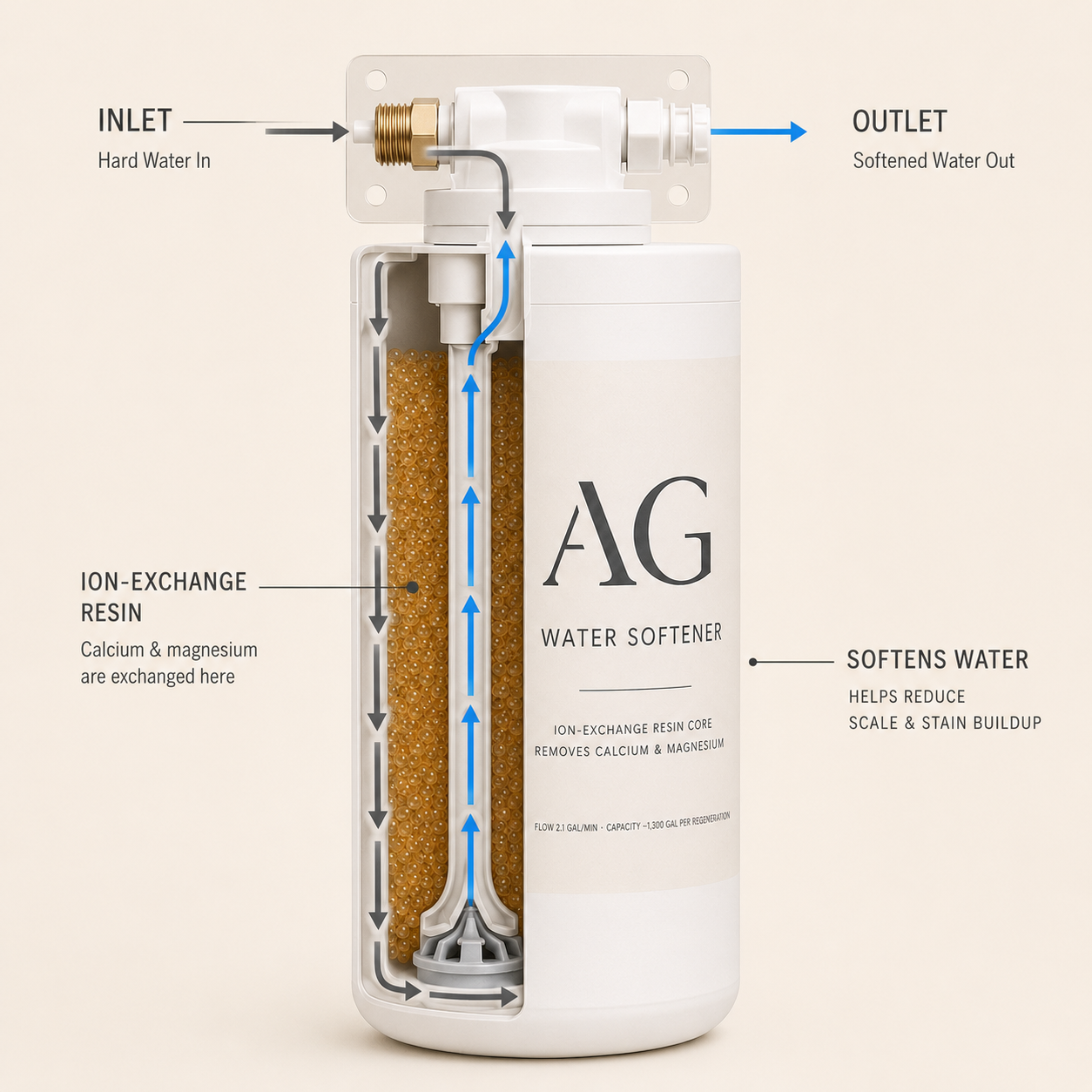
A device that softens shower water has to hold a bed of ion-exchange resin large enough to treat water at two gallons per minute, and it has to regenerate with salt when the resin fills up. That has a physical size, which is why no $18 cartridge in a 4-inch housing does it, and why the real category is small: purpose-built units mounted at the shower arm, not screw-in showerheads.
The AG Water Softener Complete Set is built this way: a resin bed at the shower arm, a no-tool install, recharges with plain salt (zero additives), and a $10 test strip makes the claim checkable on your counter. Hard water in reads 120 ppm and up; the output reads near zero. $279, 90-day money-back guarantee.
Yes, that's more than $18. It's also the difference between buying a softener and buying the word. For the full side-by-side, read the filter vs softener comparison. The full field is ranked in our shower water softener list. Renters have a separate guide to putting a water softener in an apartment.
Frequently asked questions
Are the cheap ones a scam?
They do reduce chlorine. The scam, where there is one, is the word "softener" in the title. For hardness, they do nothing you can measure.
What about showerheads with "softening mineral balls"?
Ceramic and "mineral" beads filter at best. There is no ion exchange and no salt, so hardness passes straight through.
How do I find out if I even have hard water?
Check your water free with our lookup tool, or test it yourself. Under about 120 ppm, skip softeners and buy a chlorine filter.