Shower filter vs water softener: which one fixes your water
Updated Oct 26, 2026
A shower filter removes chemicals from your water. A water softener removes minerals. People compare the two because both screw onto a shower and both promise better hair and skin, but if you buy the wrong one, your water problem stays exactly where it was, and you'll blame the product instead of the mismatch.
Here is the fastest way to sort it out.
What a shower filter actually does
A shower filter runs your water through media like KDF-55, activated carbon, calcium sulfite, or vitamin C. These are good at neutralizing chlorine and chloramine, and they catch some sediment and metals along the way.
That matters. Chlorine strips oil from hair and skin, and many people notice less dryness within a couple of weeks of installing a decent filter. Brands like Jolie and Canopy have built real businesses on this, and for chlorine, the products work.
What no filter does is soften water. Calcium and magnesium are dissolved ions, not particles. They are thousands of times smaller than the pores in carbon or KDF media, so at two gallons per minute they flow straight through. Filter brands know this. Some say it plainly, and some bury it, but the chemistry is the same for all of them. The full chemistry is on our page about why filter media can't remove hardness. And if you're looking at a listing that says softener, the ten-second listing check settles it. If you're comparing the products themselves, our ranking of shower water softeners covers the field. And if scale on the glass is what brought you here, our limescale prevention guide starts there.
More answers and resources like these in your Google results, marked as preferred.
What a water softener actually does
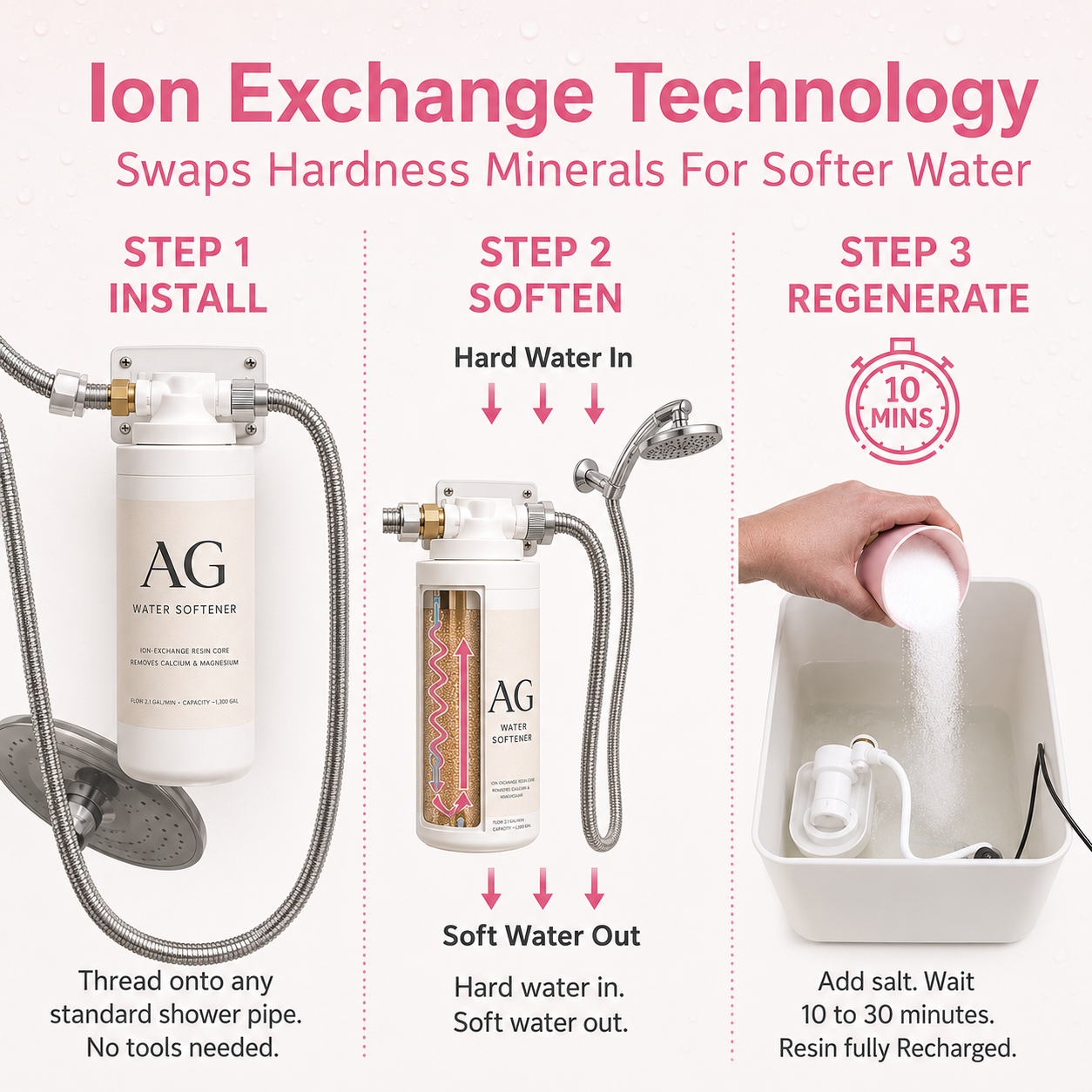
A softener uses ion exchange: water passes through a bed of resin beads that swap calcium and magnesium ions for sodium ions. This is the same process inside a $2,000 whole-house system, and it is the only consumer chemistry that removes hardness. When the resin fills up, a salt recharge in the included brine tank, about 40 minutes per cartridge, resets it. The definition of a shower water softener has its own page, with a filter and whole-house comparison.
A softener does little for chlorine. That is the filter's job. The two devices are answers to two different questions.
Which problem do you have?
Match your symptoms:
| Your symptom | The culprit | What fixes it |
|---|---|---|
| Pool smell, faded hair color, dry skin in a soft-water city | Chlorine | Shower filter |
| White crust on the showerhead, film on glass, soap that won't lather | Hardness | Water softener |
| Hair that feels coated, dull, and heavy no matter the shampoo | Hardness | Water softener |
| Straw hair AND chemical smell | Both | Softener first, filter second |
Still unsure? Two checks settle it. Look up your local water hardness with our free report tool, or run a $10 test strip on your shower water. Above roughly 120 ppm (7 gpg), hardness is doing real damage, and a filter will not touch it.
The apartment and condo problem
Whole-house softeners fix hardness, but they need a plumber, a drain line, and permission to cut into the building's supply. If you rent, own a condo, or just don't want a $2,000 install, that door is closed.
This is the gap a shower water softener fills. The AG Water Softener Complete Set is a full ion-exchange unit sized for one shower. It hangs on adhesive hooks and connects to your shower hose with no tools, recharges with plain salt (zero additives), and a $10 test strip lets you measure the before and after yourself. It costs $279 and carries a 90-day money-back guarantee. It treats about 294 gallons per recharge with both cartridges at 10 grains of hardness, roughly 14 ten-minute showers, and each recharge lasts about two weeks for one person at 10 grains with both cartridges; a second person halves that, and harder water shortens it.
The trade: AG does not remove chlorine. If your water is both hard and heavily chlorinated, soften first, because hardness causes the buildup, then add a basic filter if the chlorine still bothers you.
If you rent or own a condo, the water softener for an apartment guide covers every option that fits.
Frequently asked questions
Can one device filter and soften?
A few combo units exist. Be careful with the small ones: a cartridge that claims 15 stages in a 4-inch housing has almost no resin volume, so any softening effect is gone within days. Real softening needs a real resin bed.
Do "water softener showerheads" on Amazon work?
The $18 ones are filters with the word "softener" on the listing. Check the media list. If you see KDF, carbon, or vitamin C and no mention of ion-exchange resin and salt regeneration, it cannot soften water.
Is softened water safe for hair and skin?
Yes. The sodium added is small, far less than in a slice of bread, and softened water is why soap lathers properly and rinses clean.
How do I know it's working?
Test strips. Hard water reads 120 ppm and up; after a working softener the same strip reads near zero. That is a pass or fail result you can see in thirty seconds.
Check your water hardness free at MyApartmentWaterQuality.com, or see the AG Water Softener.