Portable water softener for your shower: the real options
Updated Oct 25, 2026
Search for a portable water softener and most of what you'll find was built for RVs: 30-pound tanks meant to sit beside a camper and treat the whole hookup. They soften water properly, and some determined apartment dwellers have rigged them into bathrooms with hose adapters and a tank parked on the shower floor.
It works. It also looks like it sounds. If you want soft water without a plumber and without a tank next to your feet, here is how the options actually compare.
What "portable" needs to mean for a shower
Three requirements, and most products fail at least one:
The unit has to soften, which means ion-exchange resin and salt regeneration. Cartridge showerheads that claim softening skip this entirely; a filter is not a softener.
It has to install without touching the building's plumbing. Thread on at the shower arm, thread off when you leave.
And it has to live in a bathroom without dominating it. This is where RV units lose, not on chemistry.
More answers and resources like these in your Google results, marked as preferred.
The RV softener route
Units like the Pro+Aqua Travel Series are real softeners at a fair price, and if you already own one for a camper, adapting it to a shower with garden-hose fittings is a legitimate weekend project. The trade-offs are the ones you'd guess: a tank on the floor or in the tub, hoses crossing the bathroom, and a regeneration process built around outdoor use. As a permanent fixture in the place you shower every day, it wears thin.
Current prices run from about $165 for compact units to about $280 for larger tanks, checked against On The Go and Pro+Aqua listings on August 19, 2026.
The shower-native route
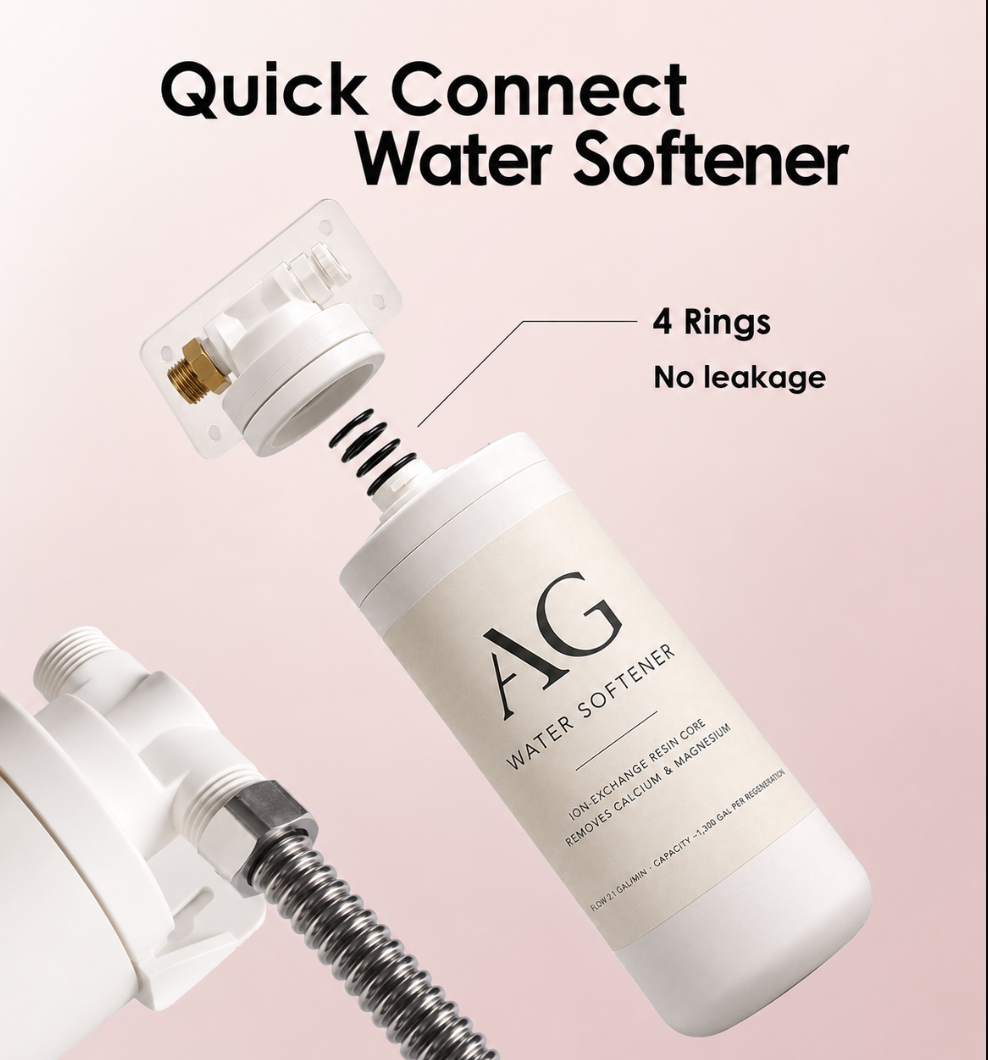
The AG Water Softener Complete Set puts the same resin chemistry in a housing designed for the shower arm. It hangs on adhesive hooks and connects to your shower hose, installs with no tools, and recharges in its included brine tank: add plain salt (zero additives) and water, plug in the pump, and each cartridge's cycle takes about 40 minutes. Each recharge lasts about two weeks for one person at 10 grains with both cartridges; a second person halves that, and harder water shortens it.
Because it hangs on adhesive hooks and connects to your shower hose, it comes with you when you move: unhook it, put the original hardware back, done. A test strip makes the before and after a number you read, not a feeling you talk yourself into. $279 with a 90-day money-back guarantee.
The trade-off in the other direction: an RV tank holds more resin, so it goes longer between recharges. AG trades some capacity for actually belonging in a bathroom. For one or two people showering daily, the recharge cadence stays a light routine.
The water softener for an apartment page handles the rest of the renter decision.
The shower softener ranking puts these options side by side.
Before you buy anything
Confirm hardness is your problem. Check your water free with our lookup tool or run a test strip; above about 120 ppm you'll feel the difference a softener makes. If your water reads soft, no softener, portable or otherwise, will change anything you notice.
Frequently asked questions
Can I take it between bathrooms or homes?
Yes. It threads onto any standard 1/2-inch shower arm, which is nearly every US shower. Moving it is the same job as moving a showerhead.
How is this different from a portable RV softener?
Same chemistry, different body. The RV unit is a freestanding tank with hose fittings; AG mounts at the shower arm, and its salt recharge is a pumped cycle of about 40 minutes per cartridge in an included brine tank.
Does portable mean less effective?
No. Softening is pass or fail chemistry: either resin exchanges the minerals or it doesn't. Size affects how often you recharge, not whether the water gets soft. A test strip lets you verify the output yourself.